NVMe vs. SATA for Databases and Caches: Throughput, Tail Latency, and Cost per GB/IOPS
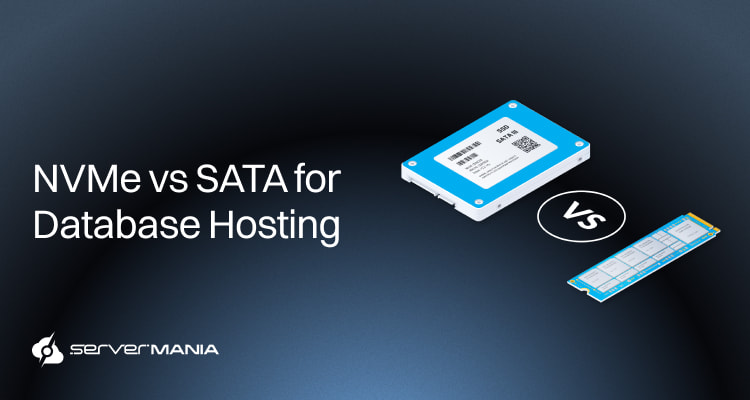
Every database workload demands fast storage and predictable latency, so organizations and teams often compare NVMe vs SATA for their purposes.
The NVMe storage uses the Non-Volatile Memory Express protocol and the Peripheral Component Interconnect Express bus, through an NVMe PCIe socket. This is what gives you faster data transfer speeds during heavy queries, making it an attractive option.
In turn, the SATA SSD options rely on the older SATA storage interface, via the SATA data connector, not PCIE connections; therefore, data transfer rates stay lower in specific locations.
So, which is better?
Here at ServerMania, we support top-tier data centers with database server hosting environments that offer speed, consistency, and reliability for high-performance computing. Our engineers work with both NVMe SSD and SATA drives to match each workload with the best possible hardware on the market.
That’s why today, we will walk you through everything you need to know when you’re up against the dilemma of NVMe vs SATA, and help you choose the right SSD.
How Important Are Storage Protocols?
The quick answer is, a lot!
Your database becomes slower when it relies on SATA SSD hardware during peak traffic. P99 latency exposes the gap between NVMe storage and SATA, even when raw specs look close on paper. Many comparisons list faster transfer data speeds, like 7 GB per second for NVMe SSD vs 550 MB per second for SATA, but these numbers do not reflect real database behavior.
Workloads care about queue depth. Most databases stay under QD32, where the SATA interface and its advanced host controller interface start to limit throughput. Tail latency matters even more, since P99 and P999 spikes break SLAs. Databases also depend on strong 4K random reads and writes, not sequential throughput; therefore, sustained performance shapes reliability, because some solid-state drives throttle during long 24/7 loads.
Did You Know❓
NVMe delivers 10x lower tail latency than SATA for database workloads, with P99 latencies of 0.75ms vs 7.5ms under load. For Redis cache layers, NVMe provides 2.5x higher ops/sec at 1/3 the latency. The cost premium of 15-20% delivers 5x, up to 10x performance per dollar for latency-sensitive workloads.

NVMe vs SATA Database: Architecture and Protocol Differences
NVMe storage and SATA SSD hardware behave differently because each type of flash storage has its own queue design and software path. There are several key differences, including the NVMe protocol, PCIE slot, complex process handling, and architecture.
Let’s go over the factors that set them apart!
Core Queue Architecture: Why NVMe Wins?
- SATA Storage uses the host SATA controller interface with one queue and 32 commands, so blocking appears fast under load. This slows transactions when many queries hit the same queue.
- NVMe SSD hardware, on the other hand, uses thousands of queues, which allows each CPU core to push work individually and without any contention, providing a noticeable speed difference.
Command Set Efficiency
SATA follows a command set shaped for hard disk drives (HDDs), so every request moves through extra steps. The NVMe uses a simpler command set that shortens each operation. This helps random reads and writes, which matter most in database workloads.
CPU Overhead and Stack
SATA requests move through more layers, which adds about 125 microseconds of overhead. NVMe removes several layers and drops overhead to about 10 microseconds. This improves response time when many clients hit the server.
The table below shows how each interface behaves once these architectural limits appear. It links the protocol differences to real throughput and latency numbers that affect a lot of database workloads.
| Interface | Theoretical | Real-World DB | Lanes | Latency |
|---|---|---|---|---|
| SATA III | 600 MB/s | 550 MB/s | 1 | 2-4ms |
| NVMe Gen3 x4 | 3,500 MB/s | 3,200 MB/s | 4 | 0.02-0.1ms |
| NVMe Gen4 x4 | 7,000 MB/s | 6,800 MB/s | 4 | 0.02-0.08ms |
| NVMe Gen5 x4 | 14,000 MB/s | 13,500 MB/s | 4 | 0.02-0.07ms |
Did You Know❓
NVMe supports 65,535 parallel queues vs SATA’s single queue with 32 commands. This architecture difference enables NVMe to handle 10x more database connections without queue saturation, reducing software overhead from 125μs to 10μs per I/O operation.
End-to-End Benchmarking: NVMe SSD vs SATA SSD
To better understand how NVMe SSD and SATA SSD compare, we ran end-to-end tests to show how each drive behaves under real pressure.
The goal is to measure performance in conditions that match production systems, so you can see how each flash technology option responds when it comes to read and write speeds.
Here’s our test configuration:
| Server | Intel Xeon W-2245, 8 cores at 3.9 GHz |
| RAM | 128 GB DDR4-2666 ECC |
| SATA Storage | 4 x Samsung 870 EVO 2 TB, RAID 10 |
| NVMe Storage | 4 x Samsung 980 Pro 2 TB, software RAID 10 |
| Operating System | Ubuntu 22.04 LTS, kernel 5.15 |
| File System | ext4 with noatime and nodiratime |
The setup stays identical for both drive types, so the results stay fair.
Using the same server, memory, file system, and operating system removes outside variables. Only the storage changes. This keeps the focus on the difference between the NVMe SSDs and SATA SSDs, also helping us compare the results to older systems and older devices.
Note: The 2.5-inch NVMe drives use PCI Express (PCIE 4.0).
FIO Configuration for Simulation:
Here are the tools used to stress each storage device with repeatable workloads:
[global]
ioengine=libaio
direct=1
runtime=300
time_based
group_reporting

[mysql-oltp]
bs=16k
rw=randrw
rwmixread=70
iodepth=32
numjobs=8

[redis-cache]
bs=4k
rw=randread
iodepth=1
numjobs=16

[mongodb-mixed]
bs=64k
rw=randrw
rwmixread=50
iodepth=16
numjobs=4
The Database Workloads Tested
Here are the workloads we’ve simulated on each storage unit. Our main goal was to mirror production behavior 1:1, so we can extract meaningful results.
MySQL 8.0 (TPC-C-Like):
This workload tests mixed reads and writes under steady concurrency:
- 100GB dataset, InnoDB engine
- 100 concurrent connections
- 70/30 read/write ratio
Redis 7.0 (Cache workload):
This workload measures low-latency access with small random operations:
- 50GB dataset
- 10,000 ops/sec baseline
- GET/SET/INCR operations
MongoDB 6.0 (Document store):
This workload evaluates insert, update, and index activity under mixed load:
- 150GB collection
- Mixed read/write/update
- Index-heavy workload
Simulation Performance Results
These results show how each storage device responds under database pressure when the system depends on the necessary connections to move data fast.
MySQL TPC-C Results (100 warehouses):
This test measures mixed reads and writes with steady concurrency. It highlights how NVMe storage keeps latency low while the SATA interface slows under load.
| Metric | SATA RAID 10 | NVMe RAID 10 | Improvement |
| Transactions/sec | 8,420 | 31,650 | 3.8x |
| p50 latency | 2.1ms | 0.31ms | 6.8x |
| p95 latency | 5.8ms | 0.52ms | 11.2x |
| p99 latency | 12.4ms | 0.89ms | 13.9x |
| p999 latency | 47ms | 2.1ms | 22.4x |
Redis Benchmark Results (redis-benchmark):
This test measures small key operations that stress latency, and it clearly shows how each drive behaves when the workload depends on fast reads and writes.
SATA Performance:
- SET: 89,285 ops/sec (p99: 3.2ms)
- GET: 142,857 ops/sec (p99: 2.1ms)
- INCR: 125,000 ops/sec (p99: 2.4ms)
- LPUSH: 71,428 ops/sec (p99: 4.1ms)
NVMe Performance:
- SET: 285,714 ops/sec (p99: 0.43ms)
- GET: 454,545 ops/sec (p99: 0.31ms)
- INCR: 400,000 ops/sec (p99: 0.35ms)
- LPUSH:222,222ops/sec(p99:0.52ms)
The bottom line here is that NVMe delivers higher throughput with lower latency across all commands. This makes it the stronger option for cache-heavy environments.
MongoDB Mixed Workload:
This test covers inserts, updates, and index activity, and it shows how each drive handles mixed operations that depend on stable latency.
- Insert rate: SATA 12K/sec vs NVMe 41K/sec (3.4x)
- Query response: SATA p99 8.2ms vs NVMe p99 1.1ms (7.5x)
- Update operations: SATA 8K/sec vs NVMe 29K/sec (3.6x)
- Index build time (10GB): SATA 312 sec vs NVMe 67 sec (4.7x)
The NVMe here keeps operations moving under parallel load, while SATA slows once the workload grows.
Queue Depth Scaling:
This test increases concurrency to show how each drive responds when more operations wait in line. Here we can observe how the NVMe continues to scale while SATA reaches its limit early at QD32.
| QD1 | SATA 15K IOPS | NVMe 45K IOPS | 3x |
| QD4 | ATA 48K IOPS | NVMe 180K IOPS | 3.8x |
| QD16 | SATA 82K IOPS | NVMe 420K IOPS | 5.1x |
| QD32 | SATA 95K IOPS (saturated) | NVMe 650K IOPS | 6.8x |
| QD64 | SATA 95K IOPS (saturated) | NVMe 920K IOPS | 9.7x |
Sustained Performance: [24-Hour Test]
We also measured how each drive behaved during a long run, and this shows how the performance changes once heat and background work start to build.
- SATA showed about a 15% drop after 4 hours
- NVMe stayed within the 3% percent variation
Also…
- SATA P99 rose from about 12 ms to 28 ms
- NVMe P99 stayed between 0.9 and 1.1 ms
Here’s what we’ve learned:
NVMe delivers 3.8x higher MySQL transactions/sec with 13.9x lower P99 latency compared to SATA SSDs. Redis operations show even larger gains with 3.2x throughput and 7.4x lower tail latency.
At queue depth 32, where databases typically operate, NVMe provides the outstanding 650K IOPS versus SATA’s 95K IOPS ceiling.

See Also: RAM vs SSD – What’s The Difference Between Memory and Storage
ServerMania Cost Analysis: Price per GB
To help you understand how much you’ll be paying for a storage service, whether it’s NVMe or SATA SSD, we’ve calculated the total cost as per real ServerMania prices.
This helps you choose the setup that gives you the best value for your workload.
| Storage Configuration | Monthly Cost | StorageCapacity | Raw $/GB | (RAID 1) |
|---|---|---|---|---|
| 4x 2TB SATA SSD | $80 | 8TB | $0.010 | $50 |
| 2x 2TB NVMe Gen4 | $40 | 4TB | $0.010 | $50 |
| 2x 4TB SATA SSD | $70 | 8TB | $0.087 | $50 |
| 2x 4TB NVMe Gen4 | $70 | 8TB | $0.087 | $50 |
These values show how close the raw costs are across both SSD form factors. NVMe delivers higher throughput for the same effective price in several configurations. SATA stays useful for lower intensity workloads, such as video editing, but it’s not the right solution for any of the higher performance levels.
When to Choose SATA?
Some workloads do not need high speed, and since not all SSDs deliver the same performance level, we can always adjust the performance/cost ratio as per the ideal use case. Here are a few use cases that focus on low cost and steady output.
- Archival/cold storage: <100 IOPS requirement
- Backup databases: Write-once, read-rarely
- Development environments: Cost over performance
- Capacity-optimized workloads: >90% sequential reads
- Budget constraints: <$200/month storage budget
SATA stays useful when performance demands stay modest because it uses flash memory built for steady output. For instance, systems that read and write rarely definitely benefit from more storage, rather than raw throughput, more RAM, speed, or reducing latency.
Note: A computer desktop use, such as web browsing and music production, demands low IOPS, so archival/cold storage setups work great with a single SSD.
When to Choose NVMe?
High-pressure systems depend on low latency and strong throughput. NVMe handles these demands with fewer delays and higher output.
- Production databases: SLA requirements <5ms p99
- Cache layers: Redis/Memcached with >100K ops/sec
- Real-time analytics: Sub-second query requirements
- Financial systems: Trading platforms, payment processing
- Multi-tenant SaaS: Performance isolation requirements
Curious Fact:
NVMe costs 78% more per GB than SATA ($0.080 vs $0.045) but delivers 3.8x better cost per IOPS ($0.0005 vs $0.0019). For database workloads requiring <5ms p99 latency, NVMe provides 52% lower cost per transaction and 57% lower 3-year TCO when performance requirements are considered.
Optimization Guide: Maximizing Database Performance
You can improve the performance when you match your settings to each storage device. The goal is to use the strengths of NVMe SSD hardware and reduce the limits in SATA SSD setups. These changes will ultimately help you reach higher throughput, lower latency, and stable write performance during traffic.
The steps below give you a clear path for tuning NVMe and SATA builds!
They work across common file system options and match the operating system settings used in data centers. You simply adjust queues, threads, and I/O behavior so your server moves large files and small operations with fewer delays.
NVMe Specific Optimizations
These settings improve how NVMe storage responds to database workloads. NVMe uses the non-volatile memory express protocol and the PCIe bus, so it reaches faster speeds and handles more parallel command queues.
Our target is to remove small limits that slow NVMe drives under load:
NVMe Kernel Parameters
echo 'none' > /sys/block/nvme0n1/queue/scheduler
echo 256 > /sys/block/nvme0n1/queue/nr_requests
echo 2 > /sys/block/nvme0n1/queue/rq_affinity
These settings reduce queue overhead and improve I/O placement across CPU cores. They help prevent a CPU bottleneck when your system handles mixed reads and writes.
MySQL NVMe Configuration
[mysqld]
innodb_io_capacity = 20000
innodb_io_capacity_max = 40000
innodb_flush_method = O_DIRECT_NO_FSYNC
innodb_page_cleaners = 8
innodb_read_io_threads = 16
innodb_write_io_threads = 16
These values optimize how MySQL uses NVMe. They match the high-speed behavior of NVMe PCIe hardware and improve concurrency during NVMe vs SATA database workloads.
Redis on NVMe
save ""
appendonly yes
appendfsync no
aof-rewrite-incremental-fsync yes
This setup reduces fsync delays and takes advantage of faster data transfer speeds. NVMe handles the I/O bursts with stable data transfer rates.
Decision Framework: How to Choose the Right Storage?
Your storage choice depends on the behavior of your workload, not a single benchmark number. There are several factors, ranging from database size to read/write ratio and growth, that decide if NVMe SSD or SATA SSD gives you better performance and better long-term value.
Here’s a quick decision framework table to evaluate your workload:
| Workload: | NVMe – Ideal Use | SATA – Ideal Use |
|---|---|---|
| Database Size | <5TB (fits on NVMe) | >20TB (capacity focused) |
| Transactions/sec | >5,000 | <1,000 |
| p99 Latency Requirement | <5ms | >20ms acceptable |
| Concurrent Connections | >100 | <50 |
| Read/Write Ratio | Write-heavy (>40%) | Read-heavy (>90%) |
| Budget per TB | >$80/month | <$50/month |
| Growth Rate | >20% monthly | <5% monthly |
⚠️Upgrade Immediately When:
There are certain signals that you can easily recognize, telling you that it’s time to upgrade. These symptoms can instantly be resolved by the NVMe technology.
- I/O Wait: When the database wait time stays above 30% and remains high even when the overall load looks normal.
- Slow Responses: Users report increasing query latency across routine actions, and the delays grow throughout the day.
- No Scaling: Adding more application servers does not improve throughput, and the system shows the same bottleneck pattern.
- Replication Lag: The delay rises beyond one second and stays elevated even when the workload drops back to baseline.
- Cache Pressure: The hit ratio falls below 90% because the cache evicts keys faster than the application can reuse them.
- Backup Overruns: The backup jobs exceed the maintenance window and continue to grow longer each week.
- Index Delays: Index rebuilds take more than one hour and slow down the rest of the workload while running.
See Also: M.2 vs. U.2 SSD Storage Explained
Your Next Step: Optimize Database with ServerMania!

Here at ServerMania, we equip you with the industry-standard tools you need to run fast and stable databases through our Database Hosting and Storage Servers solutions.
We can help you move from SATA SSD to NVMe SSD with a simple upgrade path that keeps your data online and reduces downtime. If you already have your own infrastructure, our team helps you tune it for better performance and guides you through each step of the transition.
If you’re hesitant, explore our configuration panel, go through the pricing, and take the next step today!
How to Get Started with NVMe Drives?
Follow these steps to set up the storage build that fits your workload.
- Explore ServerMania database solutions and review the options for your deployment.
- Book a free consultation to acquire a quick and full storage performance assessment.
- Choose an NVMe server configuration and build the setup that supports your growth.
Quick Tip: For special requests and additional information, get in touch with ServerMania 24/7 Support.
💬Get in touch with ServerMania – we’re available right now!
Was this page helpful?
About the author